Monday, June 19, 2006

Ruby Class Variables, Attributes and Constants

Ruby Class Variables, Attributes and Constants

(For a related post, see Use Class Instance Variables Not Class Variables)


Writing a little ruby code the other day, I wanted to use a class variables but it didn't behave as expected.


01: class Class_Variable
02: @@var = 1
03: def Class_Variable.report; @@var end
04: end
05:
06: class Child_V < Class_Variable
07: @@var = 2
08: end
09:
10: puts Class_Variable.report #=> 2
11: puts Child_V.report #=> 2
12:


I was surprised by the result. Most other languages would have the child class shadow the parent field, but Ruby shared it! Ruby does provide Class Attributes and Constants as alternatives, but each has it's own symantics.

I threw together the following code to show the differences.


01: class Class_Variable
02: @@var = 1
03: def Class_Variable.report; @@var end
04: end
05:
06: class Child_V < Class_Variable
07: @@var = 2
08: end
09:
10: puts Class_Variable.report #=> 2
11: puts Child_V.report #=> 2
12:
13:
14:
15: class Class_Attribute
16: @var = 1 #class attribute
17:
18: def initialize
19: @var = 2 #instance attribute
20: end
21:
22: def report
23: @var # instance attribute, not the class attribute
24: end
25:
26: def Class_Attribute.report
27: @var # class attribute
28: end
29: end
30:
31: class Child_A < Class_Attribute
32: @var = 3
33: end
34:
35: puts Class_Attribute.report #=> 1
36: puts Class_Attribute.new.report #=> 2
37: puts Child_A.report #=> 3
38: puts Child_A.new.report #=> 2
39:
40:
41:
42: class Class_Constant
43: VAR = [ 'a' ]
44: VAR2 = [ 'b' ]
45:
46: def self.report
47: VAR2[0]
48: end
49: end
50:
51: class Child_C < Class_Constant
52: VAR2 = [ 'c' ]
53: end
54:
55: puts Class_Constant::VAR[0] #=> 'a'
56: puts Class_Constant::VAR2[0] #=> 'b'
57: puts Class_Constant.report #=> 'b'
58: #puts Child_C::VAR[0] #=> uninitialized constant error
59: puts Child_C::VAR2[0] #=> 'c'
60: puts Child_C.report #=> 'b'
61:


First notice that Class Variables are shared with their subclass (lines 1-11) . This differs greatly from Java and C# which shadow inherited variables.

The Class Attributes and Constants are "class private". That is, the child has no access to the parent attribute/constant with the same name. Class methods however are inherited. So calling "report" for Child_A and Child_C displays a significant difference between using Class Attributes and Constants (lines 37 and 60).

Unfortunately none of these alternatives matches the behavior seen in other languages. This can cause some confusion when going from Java or C# to Ruby. Class Attributes using accessor methods is the closest match to other languages. However the syntax similarities between class attributes and instance attributes can cause problems (lines 16, 19, 23, 27).

Tuesday, June 06, 2006

Wednesday, May 24, 2006

attr_accessor meta programming

Reading Jamis Buck's article Writing Domain Specific Languages I decided to attempt his challenge to write my own attr_accessor function.

First, I was curious to see how attr_accessor was implemented in Ruby. I found the source in object.c which simply calls "rb_attr(klass, rb_to_id(argv[i]), 1, 1, Qtrue);". The "rb_attr" function is located in eval.c. If you spend a few min looking at it, you will see it has special code for handling Access Control (public, private, protected). For now, I will ignore Access Control, and just implement creating the accessor methods.

Where should attr_accessor go? Looking at the docs, you will find attr_accessor is a member of Module. To see if I had the correct location, I quickly wrote...

module Module
alias old_attr_accessor attr_accessor

def attr_accessor( *symbols )
puts "attr_accessor called with #{symbols.join(' ')}."
old_attr_accessor( *symbols )
end
end


This failed since Module is not a module, it is a class! Laughing at myself and Ruby, I corrected the definition. The code above also demonstrates how easy you can implement simple Aspect Oriented Programming in Ruby. Using alias, I give the old attr_accessor method an new name old_attr_accessor. Then overwrite attr_accessor with my own code. Any call to attr_accessor will now print out the information that it was called.

Fun so far, but I haven't really defined my own version of attr_accessor. I've simple called the old one. I found module_eval does the trick (class_eval also works since it is a synonym for Module.module_eval). The final code is...


class Module
def attr_accessor( *symbols )
symbols.each { | symbol |
module_eval( "def #{symbol}() @#{symbol}; end" )
module_eval( "def #{symbol}=(val) @#{symbol} = val; end" )
}
end
end

class Foobar
attr_accessor :foo
private
attr_accessor :bar
end

fb = Foobar.new
fb.foo = "hello"
fb.bar = "world"
puts fb.foo # >> hello
puts fb.bar # >> world


Pretty simple. Unfortunately, this demonstrates the problem where my attr_accessor doesn't know about the Access Control. Looking at the Ruby library and source, I could not find any way to query the Access Control level from within my attr_accessor. So the only solution I could find is the following hack...


class Module
alias old_public public
alias old_private private
alias old_protected protected

def public( aSymbol = nil )
if aSymbol.nil?
@__module_access_level = 'public'
old_public
else
old_public( aSymbol )
end
end

def private( aSymbol = nil )
if aSymbol.nil?
@__module_access_level = 'private'
old_private
else
old_private( aSymbol )
end
end

def protected( aSymbol = nil )
if aSymbol.nil?
@__module_access_level = 'protected'
old_private
else
old_private( aSymbol )
end
end

def attr_accessor( *symbols )
symbols.each { | symbol |
module_eval( "def #{symbol}() @#{symbol}; end" )
module_eval( "def #{symbol}=(val) @#{symbol} = val; end" )
module_eval( "#{@__module_access_level} :#{symbol}; #{@__module_access_level} :#{symbol}=" )
}
end

@__module_access_level = 'public'
end

class Foobar
attr_accessor :foo
private
attr_accessor :bar
end

fb = Foobar.new
fb.foo = "hello"
fb.bar = "world" #>> private method `bar=' called for #<Foobar:0x2855710 @foo="hello"> (NoMethodError)
puts fb.foo #
puts fb.bar #


Anyone got a better idea for handling Access Control?

Tuesday, May 16, 2006

Rubyham

It has been over a month since my last post. I have been playing around with Ruby Rails in the little spare time I can find. Sometime I might post more of my experiences with it.

In breaking news, Birmingham is getting a Ruby users group named Rubyham. Kicked off by Josh Adams, Kevin Russell and Myself. It will be fun!

Playing with Rails, I used the Act As Authenticated plugin. The plugin seems to work fine. When adding the User Activation feature, I found a few changes were needed to make me happy. I have posted them back to the User Activation page. Here is the revision with my changes at the bottom.

Monday, April 03, 2006

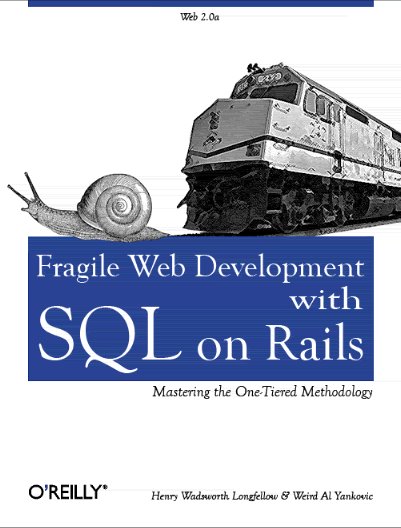
SQL on Rails


Looks like Rails is taking over the world. Here is the first new langauge fork of Rails that implements all the Rails goodness: SQL on Rails

The a short screen cast is located HERE. Eight minutes that will change your life.

Sunday, March 05, 2006

Using SSL with Ruby http-access2

Expanding on my Ruby scripts, I wanted to download information from my yahoo account. Using Ruby to get HTTP is super easy. For example, the following will print the contents of http://www.w3.org/
require 'http-access2'
client = HTTPAccess2::Client.new()
puts client.get('http://www.w3.org/').content


Sometime later, I may post some examples of parsing HTML which is also super easy. For now I will talk about getting SSL to work.

Ruby http-access2 is a great library for writting web servers and clients. In this instance I am writting a simple client to login to yahoo and download information like my bookmarks. To login to yahoo, Ruby must use SSL.

It turns out that calling SSL from ruby is pretty easy. Just add the SSL configuration information. [Also, I changed the URL in this example.]
require 'http-access2'
client = HTTPAccess2::Client.new()
client.ssl_config.set_trust_ca('ca.cert')
puts client.get('https://login.yahoo.com/config/login?').content


This works great, if you have the correct certificate. If you don't (which happened to me), you get the message:
at depth 0 - 20: unable to get local issuer certificate
http-access2.rb:1001:in `connect': certificate verify failed (OpenSSL::SSL::SSLError)
from c:/codetiger/ruby/tools/ruby/lib/ruby/site_ruby/1.8/http-access2.rb:1001:in `ssl_connect'
from c:/codetiger/ruby/tools/ruby/lib/ruby/site_ruby/1.8/http-access2.rb:1363:in `connect'
...

Figuring out what caused this error was a little confusing because of the "unable to get local issuer certificate" message. It really means "Unable to validate the certificate of the host because the trusted root certificate was not found locally." Unfortunately http-access2's docs are almost non-existent. I eventually found this information from the cURL faq! cURL and http-access2 both use OpenSSL, so the faq about this error is correct. The error message in the stack trace was from OpenSSL.

To solve this error, I had to get the correct root certificate. This is easily accomplished. First, check the web page properties in your browser. For the yahoo page, you will find yahoo is signed by "Equifax Secure Certificate Authority". I'm using Windows XP, so all I had to do was go into Control Panel -> Internet Options -> Content tab -> Certificates -> Trusted Root Certificates -> select "Equifax Secure Certificate Authority" -> Export -> select Base 64 Encoding -> save to file (EquifaxSecureCertificateAuthority.cer). [Firefox did not have an export option.]

Now that the trusted root cert is in a file, Ruby can use it...
require 'http-access2'
client = HTTPAccess2::Client.new()
client.ssl_config.set_trust_ca('EquifaxSecureCertificateAuthority.cer')
puts client.get('https://login.yahoo.com/config/login?').content


Yahoo!!!

Friday, March 03, 2006

.Net in Ruby

While creating a simple backup script (see previous post), I needed to copy more than the file's data. The backup copy needed to include the meta-data that Windows keeps for the file. Ruby (and Java or Ant) can easily copy the contents of a file, but they don't know how to copy the meta-data. The solution is to use .Net, but I wanted to write my script in Ruby.

I found the Ruby/.Net Bridge worked like magic. For example to copy a file, just use...
require 'dotnet' # Ruby / .Net bridge
System.IO.File.Copy( srcpath, destpath )


The install of Ruby/.Net Bridge was very simple. Just download, unzip, and run deploy.cmd. The ease of installation made me very happy.

After I created my backup script. I wondered if this Bridge worked with .Net v2.0. So I took a spare machine and removed .Net v1.1 to make sure the Bridge could only use v2.0. Everything worked perfect!

The one area that I had trouble was handling .Net's Enum. In .Net, the FileAttributes class is an Enum which is also a bit field (see FlagsAttribute). Using the Ruby/.Net Bridge, I could not perform bit-wise math operations on the Enum. I asked the authors, who gave me a good solution using the Parse method. For example:
require 'dotnet' # Ruby / .Net bridge

def attributeRemove( fileattribute, attribute )
Enum.parse( System.IO.FileAttributes, (fileattribute.ToString().split(', ') - [attribute]).join( ', ' ) )
end

def setReadWrite( dospath )
attrs = attributeRemove( System.IO.File.GetAttributes( dospath ), 'ReadOnly' )
System.IO.File.SetAttributes( dospath, attrs )
end

The last feature that I wanted, was to decrypt files and folders that were stored in encrypted file systems. Since Windows encryption used a key tied to the machine and user, the backup should not stay encrypted. If the machine failed it may be impossible to get the necessary key to decrypt. Unfortunately there wasn't a .Net method to decrypt the file or folder. Instead I had to call the win32api. This was pretty easy to do (however, I found the available documentation very lacking.) The following is a combination of some Utility methods, and the DecryptFile method I created for my script.
require 'Win32API'
require 'dotnet' # Ruby / .Net bridge http://www.saltypickle.com/rubydotnet/ just download it, uncompress and run deploy.cmd (per instructions on site)

class Utils
def Utils.attribute?( dospath, attribute )
if attribute.is_a?(String)
return System.IO.File.GetAttributes( dospath ).ToString().split(', ').include?( attribute )
else
raise "attribute parameter must be a String. attribute.class=#{attribute.class}"
end
end

def Utils.attributeAdd( fileattribute, attribute )
Enum.parse( System.IO.FileAttributes, fileattribute.ToString() + ', ' + attribute )
end

def Utils.attributeRemove( fileattribute, attribute )
Enum.parse( System.IO.FileAttributes, (fileattribute.ToString().split(', ') - [attribute]).join( ', ' ) )
end

def Utils.setReadWrite( dospath )
attrs = Utils.attributeRemove( System.IO.File.GetAttributes( dospath ), 'ReadOnly' )
System.IO.File.SetAttributes( dospath, attrs )
end

def Utils.setReadOnly( dospath )
attrs = Utils.attributeAdd( System.IO.File.GetAttributes( dospath ), 'ReadOnly' )
System.IO.File.SetAttributes( dospath, attrs )
end
end

class Win32API
def Win32API.DecryptFile( dospath )
Utils.setReadWrite( dospath ) if isReadOnly = Utils.attribute?( dospath, 'ReadOnly' )
result = Win32API.new('Advapi32', 'DecryptFile', %w(p i), 'i').call(dospath,0)
#todo better error checking
if result == 0
Utils.setReadOnly( dospath ) if isReadOnly
raise "DecryptFile call failed on path: \"#{dospath}\". see also: http://msdn.microsoft.com/library/default.asp?url=/library/en-us/fileio/fs/decryptfile.asp"
end
Utils.setReadOnly( dospath ) if isReadOnly
return result
end
end


An example usage...
if Utils.attribute?( path, 'Encrypted' )
Win32API.DecryptFile( path )
end